Personal project · Before high school
RC Plane
My first RC aircraft build, from selecting a repairable foam kit to getting it into the air at a local park.
The goal
Assemble and fly my first repairable RC aircraft.
My work
Kit selection, assembly, electronics repairs, and flight testing.
Hardest problem
Structural assembly errors, a damaged servo, and connector compatibility.
Result so far
The aircraft flew at the park; the flight ended in a crash landing.
The project.
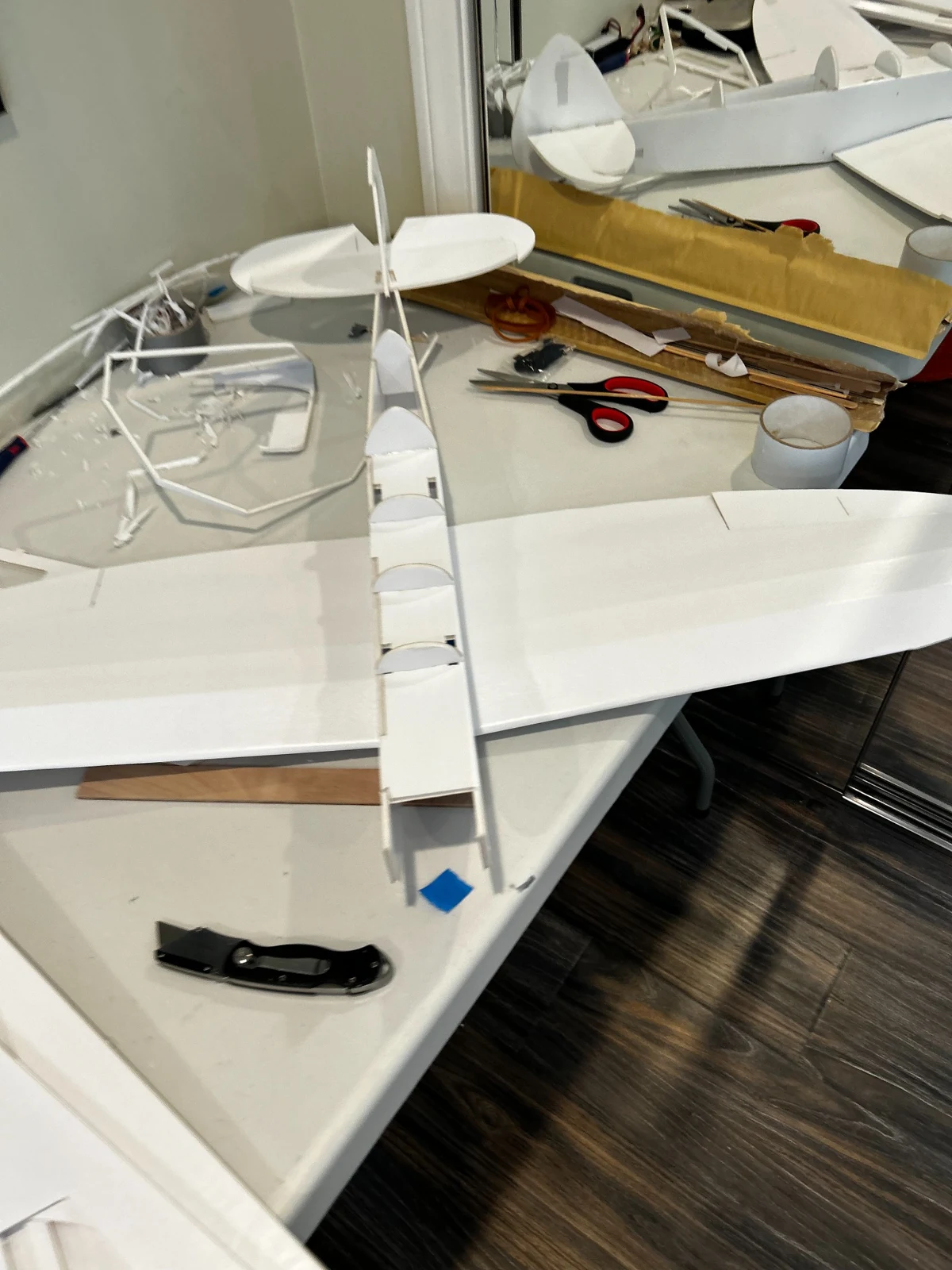
In the summer before freshman year, I chose an FT Spitfire kit for my first RC aircraft because its foam construction could be repaired after mistakes. Building it required structural corrections, a replacement wing servo, and a search for compatible connectors. I flew the completed plane around my park before a crash landing.
A foam FT Spitfire with integrated electronics.
The flight ended in a crash landing.
Engineering decisions
How it came together.
Choose a first aircraft I could repair
I wanted a manageable build that could survive a learning process. A repairable foam aircraft let me work through construction and flying without needing an entirely new airframe after every mistake. I funded the project by repairing and selling an old RC car.
Assembly became a series of repairs
I corrected an electronics enclosure that I had folded too wide, cut open the wing to replace a damaged servo, and separated a wing I had accidentally glued to the body. Finding the right small connectors also delayed the build. Each fix required understanding how the structure and electronics were supposed to fit together.
The flight was part of the project
The completed plane flew around my park and then crash-landed. Getting the aircraft airborne was a real outcome, while the landing exposed the next stage of learning: more consistent piloting and flight testing.
Development process
What changed along the way.
Construction
Correct the airframe and electronics
Work through the enclosure, wing, servo, and connector problems to complete the aircraft.
Flight
Take the build into the air
Fly the aircraft at the park, ending with a crash landing and a clear need for more piloting practice.
Project photographs
A look at the build.
Explore the hardware, design views, and development stages.
- My first RC aircraft during construction in the summer before freshman year.
Skills developed