Carrier flight and drop testOpen video
Oaks Christian · Introduction to Engineering
RC Dropper Plane
A collaboration with Mason Morgan: a larger RC carrier releases my smaller, model-rocket-powered RC plane in flight.
WhenFreshman year · 2024–2025
My roleSmall-aircraft design & build · Dropper system · Integration with Mason Morgan
StatusDrop + ignition demonstrated · Controlled flight unresolved
The goal
Carry and release a smaller RC aircraft from a larger plane.
My work
The smaller aircraft and the dropper system, integrated with Mason Morgan’s carrier.
Hardest problem
Controlling the small aircraft during flight tests in strong winds.
Result so far
Carrier takeoff, release, and ignition achieved; controlled flight remained unresolved.
The project.
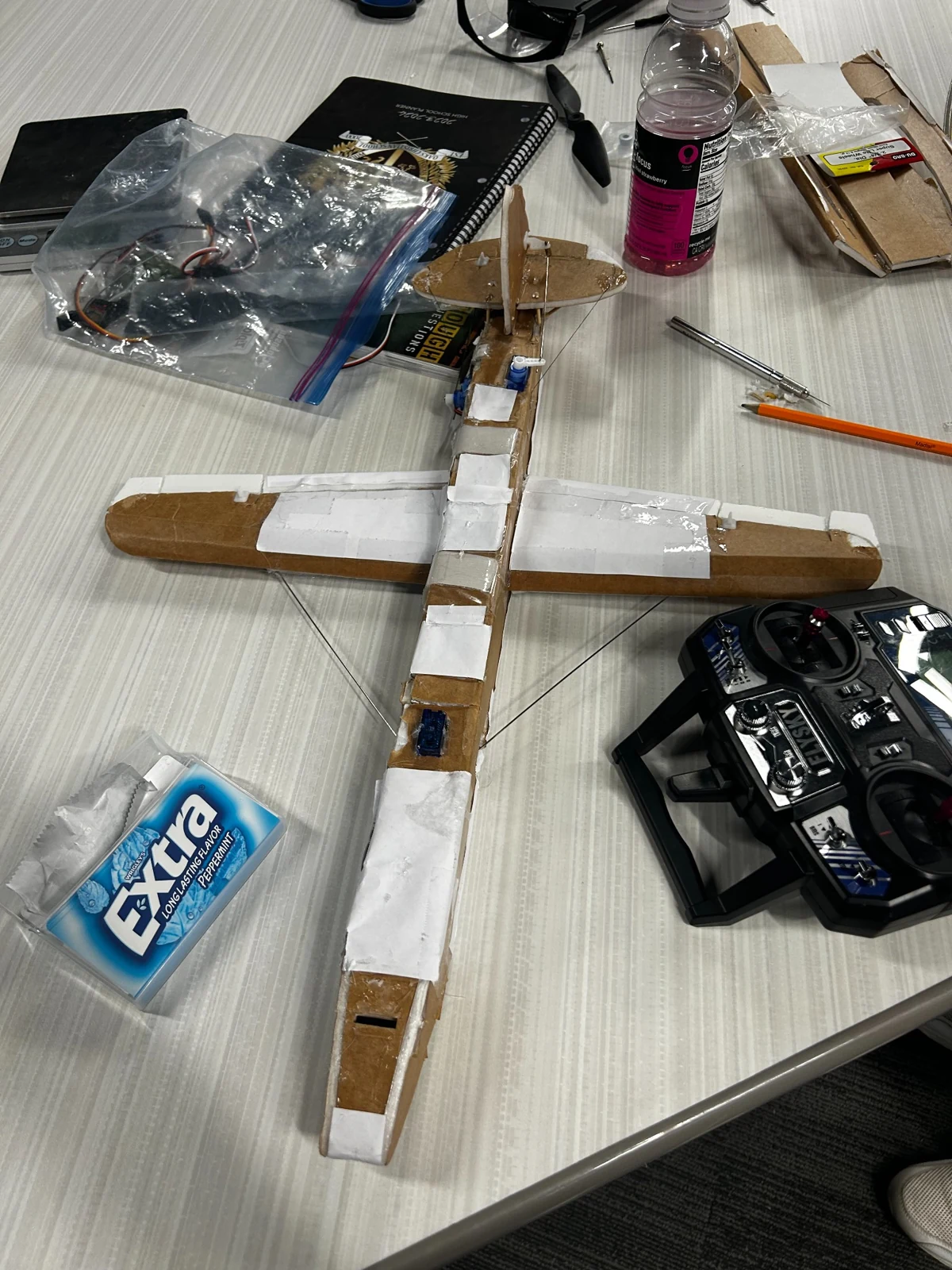
During freshman year, Mason Morgan and I combined our aircraft projects. Mason built the larger RC plane; I made the dropper system for his aircraft and designed and built the smaller RC plane it would carry. My small plane used a model rocket motor for propulsion. Across several flight tests, we achieved carrier takeoff, release of the smaller plane, and motor ignition, but strong winds and a lack of control led to crashes of my aircraft.
The wider project
Mason Morgan built the larger carrier aircraft. We combined our projects for Introduction to Engineering.
My contribution
I designed and built the smaller RC aircraft and made the dropper system on the carrier. Mason and I worked together on integration and flight testing.
Takeoff + release
The larger plane took off and dropped the smaller aircraft.
Motor ignition
Ignition achieved; an uploaded recording documents the ground firing test.
Flight control
Strong winds and a lack of control led to crashes during flight tests.
Engineering decisions
How it came together.
Two aircraft, distinct contributions
Mason built the larger carrier aircraft. I designed and built the smaller RC plane and made the dropper system that mounted on his aircraft. We worked together to integrate the two projects into a mid-flight release demonstration.
Release the small aircraft in flight
The dropper system connected my small plane to the carrier and allowed it to separate in flight. The onboard recording documents the flight-test perspective. Taking off with the carrier and releasing the smaller aircraft were milestones we achieved.
Test the model rocket propulsion
My small aircraft used a model rocket motor to propel itself. The second recording shows a ground test of the motor firing on the aircraft. We also achieved motor ignition during our flight-testing work.
Flight control remained unresolved
Strong winds and insufficient control of the small plane led to crashes during several tests. Successful release and ignition did not establish sustained, controlled flight. That distinction is central to the project’s outcome and the work a future revision would need to address.
Development process
What changed along the way.
01 · Build
Develop the aircraft and dropper
Mason built the carrier while I made the smaller aircraft and dropper system; we integrated them as a group project.
02 · Ground test
Demonstrate motor ignition
Record the model rocket motor firing on the smaller plane.
03 · Flight tests
Separate release from controlled flight
Demonstrate carrier takeoff and aircraft release, while identifying wind and control limitations through several unsuccessful small-aircraft flights.
Project photographs
A look at the build.
Explore the hardware, design views, and development stages.
- The small RC plane I designed and built for the collaboration with Mason Morgan.
Demonstrations
See the project
in action.
Original project recordings: the carrier flight/drop test and the smaller aircraft’s motor ground test.
Small-plane model rocket motor ground testOpen video
Play the recordings here, or open them in a separate tab.
Skills developed
RC aircraft designAirframe fabricationRelease mechanismElectronics integrationFlight testingTeam collaborationTest evaluation
Oaks Christian featured our collaboration during the Introduction to Engineering final presentations. The school’s post credits Mason’s carrier aircraft, my smaller plane, and our shared release mechanism, and reports a successful drop while noting that the small plane did not achieve full flight.
Oaks Christian’s project post